HIIT Workout Using Bodyweight: The Complete Guide (2026)
Everything you need to know about bodyweight HIIT workouts — exercises, sample routines, and how to get started with no equipment required.
HIIT Workout Using Bodyweight: The Complete Guide (2026)
Bodyweight HIIT workouts deliver the same cardiovascular and fat-burning benefits as gym-based training — with zero equipment and no commute. Here's everything you need to get started and keep progressing.
Quick Takeaways
- Bodyweight HIIT is as effective as equipment-based training for fat loss and cardiovascular fitness
- No equipment needed — train at home, in a hotel, or at the park
- Beginners should start with 2 sessions per week and prioritise form over speed
- Progressive overload is possible through tempo, volume, and exercise variation
Why Bodyweight HIIT Works
The engine behind any HIIT workout is intensity, not equipment. Research consistently shows that pushing your heart rate to 80–95% of maximum during work intervals triggers the same cardiovascular and metabolic adaptations whether you're using a barbell or just your own bodyweight. Exercises like burpees, jump squats, and mountain climbers are demanding enough to drive real results.
Bodyweight training also removes every friction point that kills consistency — no gym membership, no commute, no waiting for machines. You can train in your living room in 20 minutes and still get an effective workout.
The Best Bodyweight Exercises for HIIT
Not all bodyweight exercises are equal for interval training. The best ones are compound movements that elevate heart rate quickly and challenge multiple muscle groups simultaneously.
High-Intensity Moves (work intervals)
- Burpees: The gold standard — full body, high caloric demand, zero equipment
- Jump squats: Explosive lower-body power with serious cardiovascular load
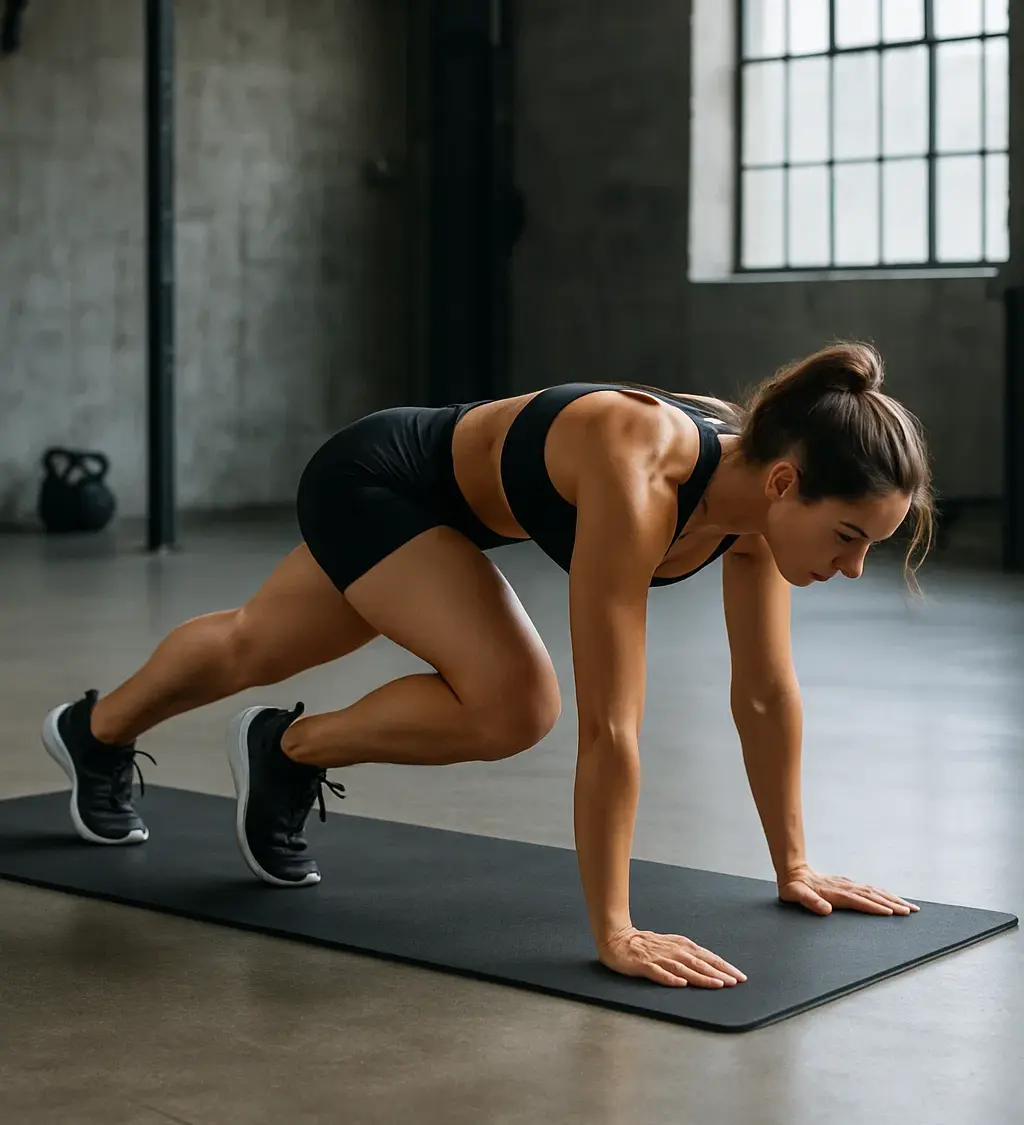
- Mountain climbers: Core-focused cardio that keeps heart rate elevated
- High knees: Simple, scalable, and effective for conditioning
- Plyo push-ups: Upper body explosive training with core engagement
- Lateral bounds: Single-leg power and stability under fatigue
Strength-Focus Moves (can be used in circuits)
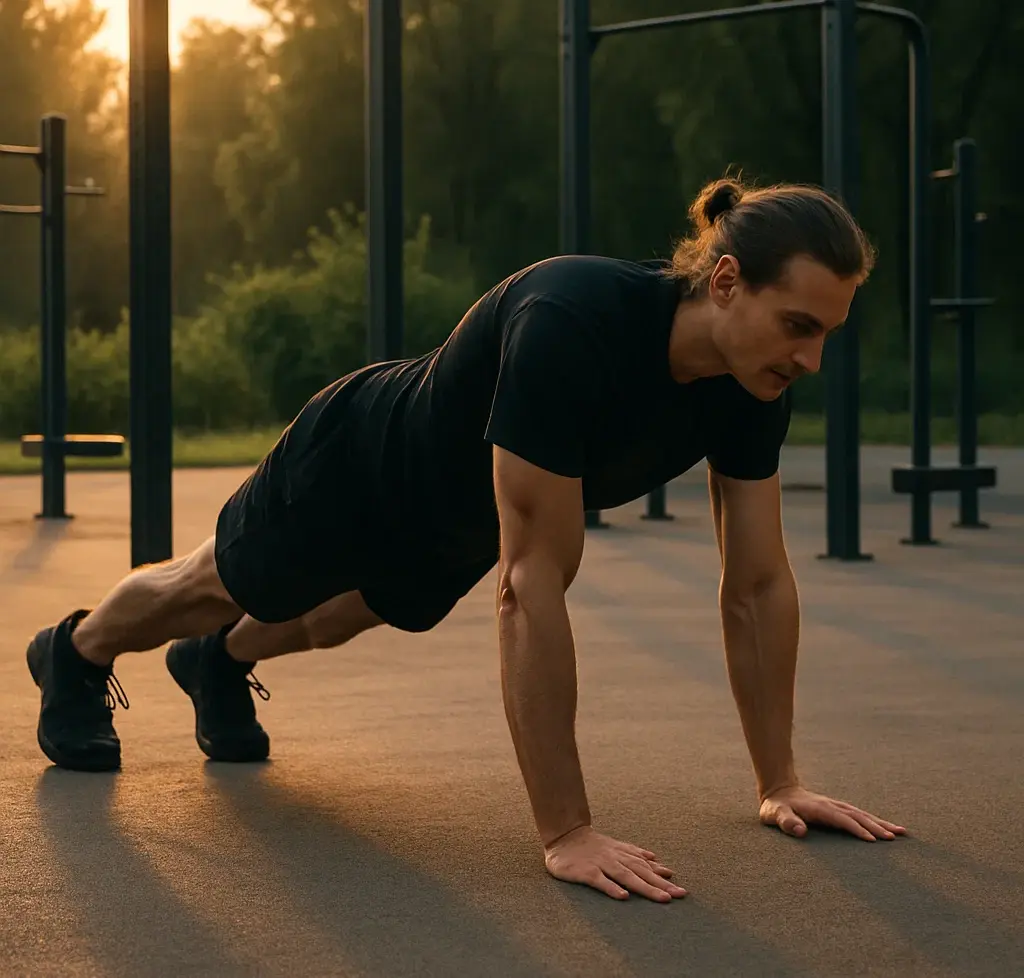
- Push-ups: Upper body strength with endless progression options
- Reverse lunges: Lower body unilateral strength with knee-friendly loading
- Pike push-ups: Shoulder strength without weights
- Glute bridges: Posterior chain activation and hip strength
- Plank variations: Core stability and anti-rotation strength
Sample 20-Minute Bodyweight HIIT Workout
This workout follows a 40-second work / 20-second rest protocol — enough intensity to drive results, enough recovery to maintain form throughout.
Warmup (5 minutes)
- Arm circles — 30 seconds
- Leg swings — 30 seconds each side
- Hip circles — 30 seconds
- Slow bodyweight squats — 60 seconds
- Inchworms — 60 seconds
- Light high knees — 60 seconds
Main Circuit — 3 rounds, 40s work / 20s rest (12 minutes)
- Burpees
- Push-ups
- Jump squats
- Mountain climbers
Rest 60 seconds between rounds.
Cooldown (3 minutes)
- Cobra pose — 60 seconds
- Child's pose — 60 seconds
- Standing quad stretch — 30 seconds each side
How to Progress Over Time
One of the biggest misconceptions about bodyweight training is that you'll quickly run out of ways to make it harder. In practice, progression is straightforward:
- Increase work intervals: Move from 30s to 40s to 50s of work
- Decrease rest: Shorten rest periods as your fitness improves
- Add rounds: Go from 2 to 3 to 4 rounds of the circuit
- Upgrade exercises: Swap push-ups for plyo push-ups, squats for jump squats
- Slow the tempo: Controlled movements increase time under tension and difficulty
- Reduce ground contact time: For plyometric moves, focus on faster, more explosive reps
Beginner vs Advanced: How to Scale
Beginner modifications
- Replace jump squats with regular squats
- Step-out burpees instead of jump burpees
- Knee push-ups instead of full push-ups
- Use a 30s work / 30s rest ratio instead of 40/20
- Start with 2 rounds instead of 3
Advanced progressions
- Add a push-up at the bottom of every burpee
- Single-leg squat jumps
- Clapping push-ups
- Tuck jumps instead of jump squats
- 50s work / 10s rest ratio
How Often Should You Do Bodyweight HIIT?
HIIT is demanding. The intensity that makes it effective also means your body needs recovery time between sessions.
- Beginners: 2 sessions per week with at least 48 hours between sessions
- Intermediate: 3 sessions per week, alternating with lighter activity or rest
- Advanced: Up to 4 sessions, with careful attention to recovery quality
On non-HIIT days, low-intensity movement like walking or mobility work supports recovery without adding stress. Avoid doing HIIT on consecutive days, especially when starting out.
Common Mistakes to Avoid
- Skipping the warmup: Cold muscles increase injury risk significantly — always spend 5 minutes warming up
- Going too hard too soon: Build your base over 2–4 weeks before pushing maximum intensity
- Poor form under fatigue: Slow down rather than letting form break down, especially on burpees and push-ups
- Training every day: Recovery is where adaptation happens — more is not always better
- Ignoring progression: If the same workout feels easy after 3–4 weeks, it's time to level up
Train Smarter with Hiitology
Hiitology takes the guesswork out of bodyweight HIIT — video-guided exercises, voice coaching, and adaptive difficulty that grows with you.
- 45+ bodyweight exercise video demonstrations
- Structured warmup, main circuit, and cooldown every session
- Adaptive difficulty — workouts evolve as you get fitter
- Voice coaching keeps you on pace during intervals
- Automatic Strava sync to track your progress
The Bottom Line
A HIIT workout using bodyweight is one of the most efficient, accessible, and effective training methods available. The science is clear: intensity drives adaptation, not equipment. With compound exercises, a structured work-to-rest ratio, and consistent progressive overload, you can build real fitness without ever stepping into a gym.
Start simple, focus on form, and add intensity gradually. The gains will follow.
Ready to Start Your HIIT Training?
Download Hiitology and get access to video-guided HIIT workouts with adaptive difficulty and voice coaching.
Download on App StoreRelated Articles
Why Motivation Is a Terrible Training Plan — And What Actually Works
Motivation is unreliable. Science-backed strategies — identity shifts, habit stacking, adaptive training, and enjoyment — are what actually keep you consistent.
Gym vs Bodyweight Training: Which Is Better?
Compare gym training and bodyweight workouts. Discover the pros, cons, and which approach is best for your fitness goals.
How to Work Out Without a Gym: Complete Home Fitness Guide
Discover effective strategies for staying fit without a gym membership. Learn bodyweight exercises, home workout routines, and equipment-free training methods.